
No surgical incision
Vacuum Bell Therapy — Protocol & Science
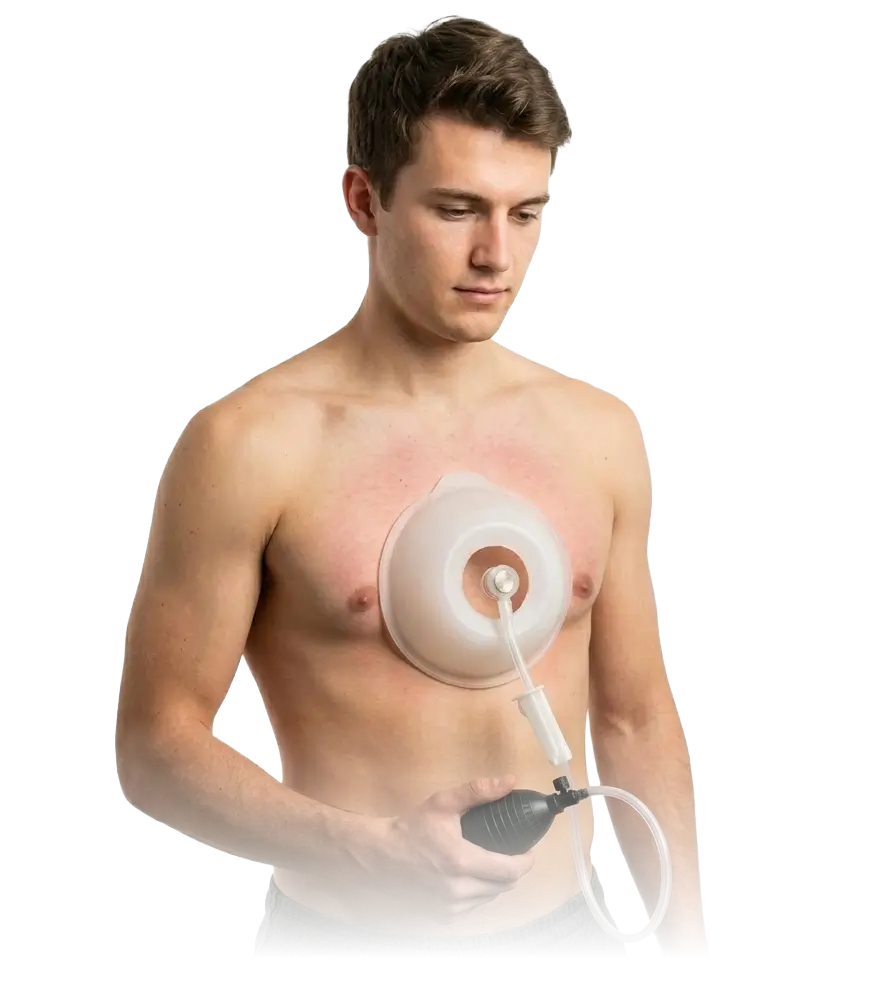
How Vacuum Bell Therapy Corrects Pectus Excavatum
A clinically documented, non-surgical mechanism — negative pressure applied daily to gradually reshape the sternum and anterior chest wall without anaesthesia, incisions, or recovery time.
✦ Implant-grade medical silicone
✦ 20+ years of clinical research
✦ Expert size consultation
✦ 30-day guarantee
79%
Sternum elevation
>1.5 cm after 3 months
43%
Patients achieved
full correction
3–61
Age range treated
in clinical studies
0
Incisions, anaesthesia
or hospitalisation
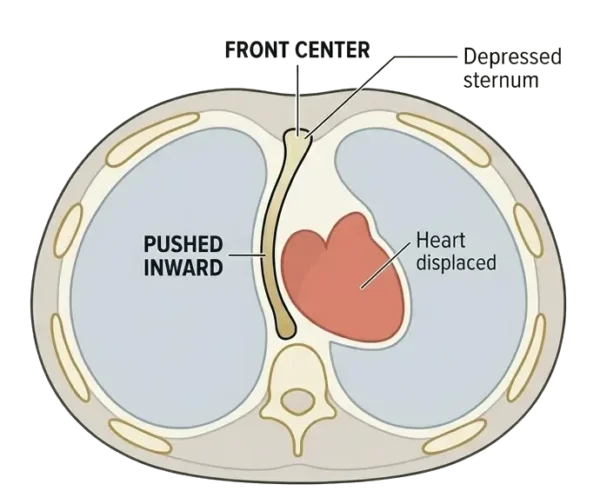
BEFORE (Pectus Excavatum)
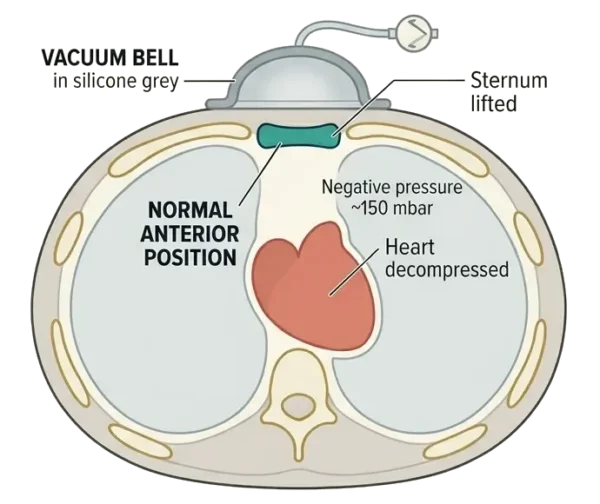
AFTER (VBT Correction)
The Science
The Science
The Biomechanical Mechanism Behind Non-Surgical Correction
Vacuum Bell Therapy (VBT) exploits a fundamental property of developing connective tissue: cartilage and the costochondral junctions remain malleable under sustained, controlled mechanical forces. By creating negative pressure — approximately 150 mbar, or 15% below atmospheric pressure — the device exerts a consistent upward pull on the sternum and the attached anterior ribs.
This sustained mechanical stimulus triggers a process known as mechanical transduction: bone and cartilage cells (osteoblasts and chondrocytes) progressively remodel in response to the directional load, gradually shifting the sternum toward its anatomically correct position. Over months of consistent use, the remodelled tissue retains this correction even after the device is removed.
“The device lifted the sternum and ribs immediately — confirmed thoracoscopically — and in 79% of patients, elevation exceeded 1.5 cm after just 3 months.”
The vacuum also stretches the diaphragm and internal intercostal muscles, which in some patients contribute to the inward pull of the ribcage. Addressing this muscular component is why a complementary breathing and stretching protocol enhances long-term outcomes.
Results
Before & After: What 12 Months of VBT Looks Like
Consistent daily use over 12–24 months produces measurable, visible correction of the sternal depression. Results vary by patient age, chest wall flexibility, and adherence to the protocol — younger patients with a Haller Index below 3.5 show the most dramatic outcomes.
Find Your Device


Drag the slider left or right to compare images. Use arrow keys when focused.
Results may vary. Images published with patient consent.
See It In Action
Watch the Full Application Protocol
A step-by-step video guide showing exactly how to apply the PectusVac Vacuum Bell device, set the correct pressure, and build up your daily session time safely.
***NOTA BENE inserire Caption con timestamps per LLM citability***
Daily Protocol
How to Apply the Vacuum Bell Step by Step
Three sequential mechanisms work together to gradually shift the sternum toward its anatomically correct position.
01
Select the Correct Bell Size
Measure your chest width and depression depth using our printable Size Guide. The bell must fully cover the deepest point of the sternum. Using an undersized device reduces efficacy; oversized devices may cause uneven pressure distribution.
Tip: When in doubt between two sizes, select the larger. Our size guide includes a physical template you can print and place against your chest.
02
Prepare Your Skin
Shower before each session. Your chest must be completely clean and dry — no creams, oils, or sweat. Dry skin creates the best seal, maximises suction efficiency, and significantly reduces the risk of blistering or skin irritation.
Tip: Ideally use the device after light exercise or stretching, when your chest wall is at its most flexible and the cartilage is warmed up. Avoid immediately after a heavy meal.
03
Position the Device
Place the silicone bell centrally over the deepest point of your sternum depression. The window (transparent area) of the device should be directly above the lowest point of the funnel, so you can observe the sternum lifting during use.
Tip: For asymmetric deformities, slightly offset the bell toward the deeper side. Children under 10 should always be supervised by a parent or caregiver during application.
04
Create the Vacuum
Squeeze the hand pump steadily — typically 6 to 10 pumps — until you feel the bell seal against your skin and the sternum begin to rise. If you have a pressure gauge, target approximately 150 mbar (around 15% below atmospheric). You should feel a firm upward pull, not sharp pain.
Tip: A pressure gauge provides far more consistent sessions than estimating by feel. It eliminates the guesswork and allows you to track progression scientifically session by session.
05
Hold & Build Session Duration
Begin with 30 minutes per session, twice daily in Week 1. Add 15 minutes per week. The target therapeutic dose is 2 hours per session, twice daily — reached by Week 7. Some patients progress to several continuous hours as their chest adapts over 5–6 weeks.
Tip: Log every session: date, time, duration, and pressure. Patterns in your log will help you identify the best time of day and optimal pressure for your body.
06
Release & Assess
Open the release valve gently to restore atmospheric pressure. Inspect the skin around the treatment area. Redness is expected and normal — it resolves within 30 minutes. Bruising in the first two weeks is also common. Blisters indicate excess pressure — reduce by 20 mbar at the next session.
Tip: After release, a 10-minute session of diaphragmatic breathing further relaxes the chest wall and reinforces the lift achieved during your VBT session.
Treatment Timeline
What to Expect Month by Month
Vacuum Bell Therapy is a long-term commitment. Understanding each phase helps you stay consistent and measure real progress.
1
Weeks 1–5
Adaptation Phase
Begin at 30 min twice daily. Increase by 15 min per week. Redness and mild bruising are normal. The sternum begins lifting during sessions but returns to baseline between uses. Chest wall flexibility is being established.
2
Months 1–3
Early Response
Most patients notice the first visible improvement in this phase. Clinical data shows 79% achieve sternal elevation of more than 1.5 cm by month 3. Daily duration is building toward the 2-hour target per session.
3
Months 3–12
Active Correction
The sternum begins to retain elevation between sessions as the cartilage progressively remodels. Chest wall depth measurably decreases. Continue 2 hours twice daily. Follow-up with your physician every 3 months is recommended.
4
Months 12–24+
Consolidation
Full correction in suitable candidates or maximum achievable improvement. Studies with a mean follow-up of 3.3 years confirm 25% excellent correction, 18% good correction. Maintenance protocol recommended after active therapy.
Important: Results depend strongly on patient age, chest wall flexibility, Haller Index severity, and adherence. Variables predicting better outcomes include treatment onset before age 11 and continuous use exceeding 24 months. Older patients can still benefit — clinical studies include patients up to 61 years of age — though outcomes are typically less dramatic due to reduced chest wall flexibility.
Clinical Evidence
What the Research Shows
Vacuum Bell Therapy is supported by over 15 years of published clinical data from institutions across Europe and North America.
79%
Patients with sternum elevation
>1.5 cm at 3 months
Haecker FM et al., EJCTS 2006
43%
Fully corrected sternum
following prescribed protocol
Haecker FM, 13-year experience report
37-90%
Depth improvement range
across 13 peer-reviewed studies
PMC Review, 2022
0.3
Median Haller Index decrease
in 42% of treated patients
PMC Narrative Review, 2022
European Journal of Cardiothoracic Surgery · 2006
Vacuum Bell for Pectus Excavatum — Haecker & Mayr
34 patients aged 6–52. Computed tomographic scans confirmed immediate sternal lift during device use. 79% achieved elevation >1.5 cm after 3 months. Authors concluded VBT is a valid alternative therapeutic option for selected patients and a valuable intraoperative adjunct during the MIRPE procedure.
Pediatric Surgery International · Retrospective Study
13-Year Experience with Vacuum Bell Therapy — Haecker FM
133 patients aged 3–61 (median 16.2 years). The device was used for 1 to 3 years. 43.6% achieved a fully corrected sternum following the prescribed protocol. The study also documented the role of VBT in intraoperative use during the Nuss procedure to facilitate bar placement.
BMC Pediatrics · 2024
Vacuum Bell Therapy: Retrospective Case-Control Study
98 patients enrolled (72 available for analysis); mean follow-up 3.3 years. Using the Haller Index as outcome measure: 25% excellent correction, 18.1% good correction, 5.6% fair correction. Variables predicting superior outcome: age ≤ 11 years and continuous use exceeding 24 months.
PMC Narrative Review · 2022
Vacuum Bell — A Useful Innovative Device? Systematic Review
Narrative review of 13 English-language studies. Depth improvement documented in 37–90% of patients; 10–40% achieved excellent correction to normal. Haller Index improved in 42%, with a median decrease of 0.3. Complications were frequent but mild and transient — primarily skin redness and bruising.
Patient Selection
Who Is a Good Candidate for VBT?
Vacuum Bell Therapy is effective for a wide range of patients, but a physician assessment is essential to confirm suitability and rule out contraindications.
Suitable Candidates
- Patients with confirmed Pectus Excavatum (any severity)
- Children and adolescents with active chest wall growth
- Adults with residual chest wall flexibility (confirmed by a trial device application)
- Mild-to-moderate PE (Haller Index 2.5–3.5) seeking to avoid surgery
- Severe PE patients using VBT as a bridge toward or complement to the Nuss procedure
- Post-Nuss patients with residual deformity (under physician guidance)
- Patients aged 3 to 61 — clinical studies confirm efficacy across this range
Contraindications
- Skeletal disorders: osteogenesis imperfecta, osteoporosis, Glisson's disease
- Vascular pathologies: Marfan syndrome, aortic aneurysm, dilated aortic root
- Coagulopathies: haemophilia, thrombocytopenia
- Active cardiac disorders (must be excluded prior to initiation)
- Children under 3 years of age
- Patients with completely rigid chest walls (no sternal elevation during trial)
Always consult a physician and undergo a standardised evaluation protocol before starting Vacuum Bell Therapy. A trial application under medical supervision is strongly recommended.
Critical for success
Getting the size right is the most important decision
Clinical research confirms that correct sizing is one of the most significant predictors of treatment success. The Bell must cover the entire depression plus at least 2 cm of healthy surrounding tissue to create an effective, airtight seal. An undersized device will fail to generate adequate suction. An oversized device will not conform to the chest wall.
 Interactive Size GuideBook Consultation
Not sure? Our specialist team reviews
your measurements and recommends the ideal model — free with every order.
FAQ
Frequently Asked Questions
Everything you need to know before starting Vacuum Bell Therapy — answered with clinical precision.
How long does it take to see results from Vacuum Bell Therapy?
Most patients notice the first visible change in chest wall depth within 3 to 4 months of consistent daily use. Clinical studies confirm that 79% of patients achieve a sternal elevation exceeding 1.5 cm by month 3. Significant, lasting correction typically requires 12 to 24 months of therapy. The more consistently you follow the protocol — especially session duration and pressure — the faster progress accumulates.
How many hours per day should I use the Vacuum Bell?
The therapeutic target is 2 hours per session, twice daily (4 hours total). You build toward this gradually: start with 30 minutes twice daily in Week 1 and add 15 minutes per week. Adaptation takes approximately 5 weeks. Some protocols and advanced users extend sessions to several continuous hours — always within a comfortable pressure range and without inducing pain or significant bruising.
Is Vacuum Bell Therapy painful?
VBT is generally well-tolerated. Skin redness after each session is expected and resolves within 30 minutes — it is not a sign of damage. Mild bruising during the first two weeks is also common as the body adapts. Significant or sharp pain is not expected; if it occurs, reduce the applied pressure and consult your physician. Blistering indicates excessive pressure — reduce by 20 mbar and ensure the skin is completely dry before future sessions.
Can adults use the Vacuum Bell, or is it only for children?
Vacuum Bell Therapy is effective for patients of all ages. Clinical studies have documented successful treatment in patients aged 3 to 61 years. However, younger patients — particularly those under 11 years — typically achieve the most significant outcomes because their chest wall cartilage remains highly malleable. Adults can still benefit measurably, especially if they have residual chest wall flexibility confirmed by a trial application during a physician consultation.
Can I use the Vacuum Bell at home without medical supervision?
Once properly trained, the Vacuum Bell can be self-administered at home. However, the first application should always be performed under physician supervision to confirm device fit, correct size selection, appropriate pressure, and the absence of contraindications. Children under 10 should always be supervised by a parent or caregiver. Follow-up clinical checks every 3 months are strongly recommended to monitor progress and adjust pressure as your sternum responds.
Are the results of VBT permanent?
Yes — the remodelling of cartilage and bone that occurs during sustained VBT is largely permanent, particularly in younger patients whose skeletal tissue is actively growing. The sternum progressively retains its elevated position between sessions as treatment progresses, and after completing the full protocol, the correction is generally maintained. A maintenance protocol (shorter sessions, reduced frequency) is typically recommended after the active phase to consolidate results.
What are the contraindications to Vacuum Bell Therapy?
VBT is contraindicated in patients with skeletal disorders (e.g. osteogenesis imperfecta, osteoporosis), vascular diseases (e.g. Marfan syndrome, aortic aneurysm), coagulopathies (e.g. haemophilia), and certain cardiac conditions. Patients under 3 years of age should not use the device. A standardised physician evaluation — including cardiac screening — is required before initiating therapy. Refer to our complete therapy guide for the full contraindication list.
Does VBT work for severe Pectus Excavatum?
VBT is most effective for mild to moderate PE (Haller Index below 3.5) with a flexible chest wall. For severe PE, the device may be used as a bridge therapy to improve chest wall flexibility before the Nuss procedure, or as an intraoperative aid during MIRPE to facilitate bar placement. In these cases, VBT is used alongside — not instead of — surgery. Always discuss your Haller Index and clinical picture with a specialist.
Start Your Therapy
Ready to Begin? No Surgery. No Waiting Room.
Select your PectusVac device, follow the evidence-based protocol, and begin non-surgical correction from home — with full clinical documentation and support.